
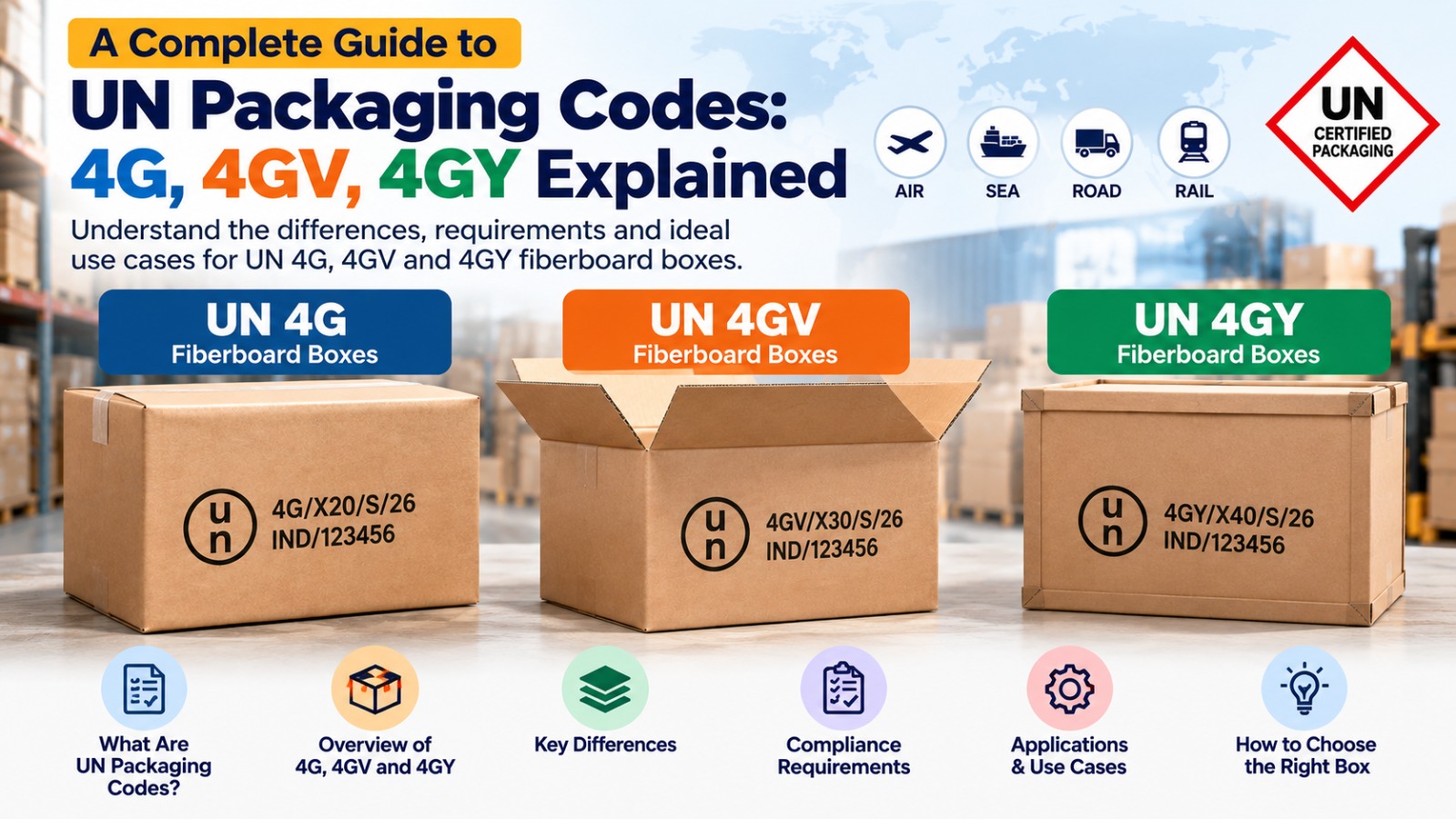
4G vs 4GV vs 4GY Fiberboard Boxes: What's the Difference?
If you have shopped for UN-approved fiberboard boxes, you have probably noticed the codes stamped on the side: 4G, 4GV, 4GY, and a string of numbers after them. They look similar, but they are not interchangeable. Each code tells you something specific about how the box was tested, what it can hold, and which packing group it is rated for.
Picking the wrong one is not a small mistake. If your box's UN mark does not match your product and its inner packaging, carriers can reject the shipment on the spot, and customs can hold your cargo indefinitely. This guide walks through 4G vs 4GV vs 4GY fiberboard boxes so you know exactly what you are buying and why it matters.
First, What Does the "4G" Part Mean?
Every UN packaging code starts with a number and a letter that describe the packaging type and material. In "4G," the 4 means the packaging is a box, and the G means it is made of fiberboard (what most people call corrugated cardboard). So any code starting with 4G is a fiberboard box tested under the UN performance-oriented packaging system.
The extra letter or letters after "4G" tell you the real story: whether the box was tested with one specific inner packaging or several, and which packing group it can legally carry.
4G Fiberboard Boxes: Tested With a Specific Inner
A plain 4G box is tested and certified alongside one exact inner packaging configuration. If the box passed its drop, stack, and vibration tests with a 1-liter glass bottle wrapped in a particular cushioning material, that is the only combination you are allowed to use inside it. Swap in a different bottle, skip the cushioning, or change the closure, and you have invalidated the certification, even though the box itself looks unchanged.
This makes 4G boxes a good fit when your shipment always uses the same inner container, like a specific paint can or a standard plastic jerry can. It also tends to allow a higher gross weight allowance, since the entire tested combination, inner packaging, cushioning, and contents, was accounted for during the original test.
4G boxes can be rated to Packing Group I, II, or III depending on how rigorously they were tested. You will see this on the mark as an X (Group I), Y (Group II), or Z (Group III) code.
4GV Fiberboard Boxes: Built for Flexibility
The V in 4GV stands for "variation." A 4GV box is tested to accept a range of suitable inner packagings rather than one fixed combination. That means you could use glass bottles, plastic containers, or small steel drums inside the same certified box, as long as the goods are compatible and the required absorbent material is present to soak up the contents if something leaks.
This flexibility comes with two trade-offs worth knowing:
Weight allowance works differently. With 4GV packaging, the maximum gross mass of the inner packaging generally cannot exceed half the weight used during the original drop test. The remaining allowance covers cushioning, absorbents, and the box itself.
4GV boxes are automatically tested to the toughest standard. Since they need to handle a wider mix of inner containers and conditions safely, 4GV packaging is tested to Packing Group I level, the X rating. That also makes it valid for Group II and III shipments, so a 4GV box gives you more flexibility on which materials it can legally carry.
4GV is the better choice when your inner packaging varies from shipment to shipment, or when you would rather standardize on one box type for several different products instead of stocking a separate 4G box for each configuration.
4GY Fiberboard Boxes: Purpose-Built for the Y Performance Level
4GY is not a separate structural category the way 4GV is. It is a 4G box that has been specifically tested and certified for the Y performance level, meaning it is rated for Packing Group II (medium danger) and, by extension, Packing Group III (minor danger) materials. The Y in the code refers to the same performance rating system used across all UN packaging, not just boxes.
You will typically see 4GY boxes used for liquids and solids that fall into the medium-hazard tier, things like certain solvents, cleaning agents, or moderately hazardous industrial liquids, where a Group I (X-rated) box would be more packaging strength than the shipment actually requires. Choosing a 4GY box instead of an X-rated 4G or 4GV box for these products keeps you compliant without paying for testing and material strength you do not need.
Quick Comparison: 4G vs 4GV vs 4GY
| Feature | 4G | 4GV | 4GY |
|---|---|---|---|
| Inner packaging | One fixed, tested combination | Various suitable inners | Depends on the specific tested design |
| Packing group rating | Can be X, Y, or Z | Always X (also covers Y and Z) | Y (covers Group II and III) |
| Best for | Consistent, repeat shipments with the same inner | Mixed or changing inner packaging | Medium-hazard liquids and solids |
| Absorbent requirement | Only if the regulation requires it | Mandatory, sized to fully absorb the contents | As tested for the specific design |
| Weight allowance basis | Full tested combination weight | Half the drop-test inner weight, plus cushioning | Set by the specific Y-rated test |
Reading the Full UN Mark on a Fiberboard Box
Once you know the base code, the rest of the marking follows a standard order. A typical example looks like this: UN 4G/Y24.5/S/26/IND/M1234.
UN – Confirms the package meets the United Nations standard.
4G – Box made of fiberboard (or 4GV/4GY for the variations covered above).
Y24.5 – Performance level (Y = Packing Group II/III) and either the specific gravity for liquids or the gross mass for solids.
S – Indicates the box is intended for solids or inner packagings, rather than free liquids.
26 – Year of manufacture.
IND – Country that authorized the certification.
M1234 – Manufacturer or certifying agency code.
Here is why this matters in practice: if your product's specific gravity is higher than the number on the mark, or if your packing group does not match the letter shown, the box is not legally usable for that shipment, no matter how well it is built.
Choosing Between 4G, 4GV, and 4GY
A simple way to decide:
Use 4G if your shipment always uses the exact same inner container and you want the highest possible weight allowance for that specific setup.
Use 4GV if your inner packaging changes between shipments, or if you want one box type that can legally cover Packing Groups I through III.
Use 4GY if your material falls into the medium-hazard range and you do not need the added (and costlier) strength of an X-rated box.
Whichever code fits your product, the certification only holds up if the box was packed exactly as tested, with the correct inner packaging, cushioning, and closure method.
Why IIP Certification Matters for Boxes Shipped From India
A UN mark by itself is not enough to export dangerous goods from India by air or sea. Your fiberboard box also needs a valid certificate from the Indian Institute of Packaging (IIP), the government-authorized body under the Ministry of Commerce responsible for testing and certifying dangerous goods packaging in India. Without a current IIP certificate backing the UN mark, airlines and shipping lines will not accept the cargo.
This is where sourcing from a manufacturer that handles both sides of the requirement saves a lot of back and forth. Needhi DG Packaging, based in Mumbai, manufactures UN-approved and IIP-certified fiberboard boxes across the 4G, 4GV, and 4GY range, alongside other IIP-certified packaging including wooden boxes, IIP Certificates Services, FIBC jumbo bags, and IBC tanks. Each box is built and tested to match a specific packing group, so you are not guessing which code applies to your shipment.
Common Mistakes to Avoid
Reusing a 4G box with a different inner container than the one it was tested with. This quietly voids the certification even though nothing looks wrong from the outside.
Assuming 4GV means "anything goes." The inners still need to be suitable for the specific dangerous goods, and the required absorbent must be present.
Choosing an X-rated box for a Group III product out of caution. It is not a compliance issue, but it does add unnecessary cost for strength you do not need.
Letting IIP certification lapse. Certificates are valid for 9 months for non-ISO-certified manufacturers and 18 months for ISO-certified ones. An expired certificate makes an otherwise correct box non-compliant.
Final Thoughts
The difference between 4G, 4GV packaging, and 4GY fiberboard boxes comes down to how the box was tested and what that testing allows you to put inside it. 4G locks you into one specific inner packaging setup but often allows a higher weight limit. 4GV trades some weight allowance for flexibility across different inner containers and automatically covers all three packing groups. 4GY sits at the Y performance level, built specifically for medium-hazard materials.
Matching the right code to your product, and pairing it with a valid IIP certificate for shipments out of India, keeps your cargo moving without delays. If you are unsure which fiberboard box code fits your material, a certified supplier like Needhi DG Packaging can walk through your product's packing group and recommend the right box before you commit to a production run.
Frequently Asked Questions
- 1. Can I use a 4GV box instead of a 4G box for the same product?
- 2. Does 4GY mean the box can only carry liquids?
- 3. What happens if I change the inner packaging in a 4G box?
- 4. Is a 4GV box always more expensive than a 4G box?
- 5. Do I still need IIP certification if my box already has a UN mark?