
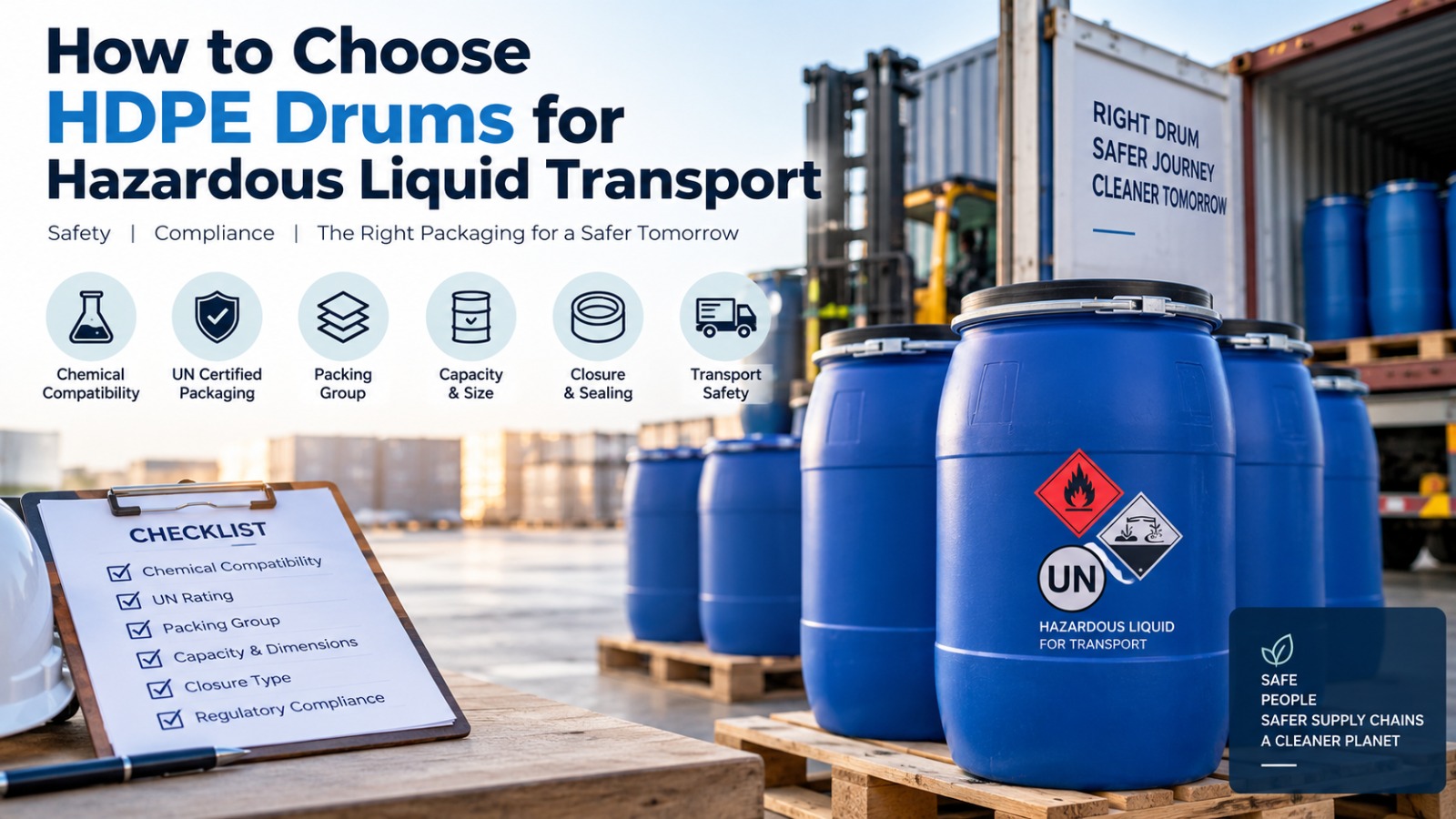
How to Choose HDPE Drums for Hazardous Liquid Transport
Picking a drum for hazardous liquids is not just about finding something the right size. The wrong choice can mean a rejected shipment, a leak in transit, or worse, an incident that puts handlers at risk. HDPE drums are one of the most common choices for hazardous liquid transport because they resist corrosion, weigh less than steel, and hold up well against a wide range of chemicals. But not every HDPE drum is built the same, and picking one without checking a few key factors is a mistake many first-time shippers make.
This guide walks through how to choose HDPE drums for hazardous liquid transport, covering the specifications that actually matter, how to read the UN marking, and what to check before you place an order.
Why HDPE Drums Are a Common Choice for Hazardous Liquids
High-density polyethylene (HDPE) is popular for hazardous liquid packaging for a few practical reasons:
Chemical resistance. HDPE holds up against a wide range of acids, alkalis, solvents, and industrial liquids that would corrode untreated steel.
Lighter weight. Plastic drums are easier to handle manually and reduce shipping weight compared to equivalent steel drums.
Cost. For many hazard classes, HDPE drums cost less than steel or stainless steel alternatives without sacrificing compliance.
No internal lining needed. Unlike some steel drums that require a liner for corrosive contents, HDPE is often compatible with the liquid directly.
That said, UN Approved HDPE Barrels is not universally compatible with every chemical. Some strong oxidizers and certain solvents can degrade plastic over time, so checking chemical compatibility is still a required step, not an optional one.
Open Mouth vs Closed Head: Know What You're Actually Shipping
The first real decision point is the drum's opening style, and this depends entirely on the physical state and handling needs of your product.
Open mouth (open head) drums have a removable lid, usually secured with a bolt ring or lever-lock band. They give you full access to load and empty the drum, which makes them a better fit for viscous liquids, sludges, or contents that need to be scooped or poured with wide access.
Closed head (tight head) drums have a fixed top with threaded bung openings for filling and dispensing. They are generally the preferred choice for pourable, flowable liquids since the sealed design limits vapor loss and reduces the risk of spillage during handling.
If your hazardous liquid is thin and free-flowing, a closed head design usually makes more sense for containment. If it is thicker or needs periodic access for mixing or dispensing tools, open mouth is the more practical option. Either way, the drum still needs to be UN-tested and rated for liquids in the specific opening style you choose.
Matching the Drum to the Packing Group
Every hazardous liquid is assigned a UN packing group, I, II, or III, based on how dangerous it is. This assignment directly determines what the drum needs to be tested and rated for.
Packing Group I (great danger): Requires drums tested to the highest performance level, marked with an X.
Packing Group II (medium danger): Requires at least a Y-rated drum.
Packing Group III (minor danger): Requires at least a Z-rated drum.
A drum rated for a higher packing group can also legally carry lower-risk materials (an X-rated drum can hold Group II or III liquids), but the reverse is never true. Buying a Z-rated drum for a Group I liquid is a compliance violation an inspector can spot instantly from the drum's own markings.
Checking Specific Gravity, Not Just Volume
This is one of the most overlooked steps when selecting HDPE drums. The UN mark on a drum lists a maximum specific gravity (relative density) it was tested for, not just a volume capacity. If your liquid is denser than water, and many industrial chemicals are, a drum tested only up to a specific gravity of 1.2 may not be legally usable for it, even if the liquid physically fits inside.
Before finalizing a drum size, check your product's SDS for its specific gravity and compare it against the number printed in the drum's UN mark. If your liquid exceeds that rating, you need a drum tested for a higher specific gravity, not a bigger drum of the same rating.
Reading the UN Mark on an HDPE Drum
A typical UN mark on a plastic drum looks something like this: UN 1H1/Y1.4/150/26/IND/M1234.
| UN mark element | Example | What it tells you |
|---|---|---|
| UN symbol | UN | Confirms the package meets the United Nations standard. |
| Packaging type | 1H1 | Plastic drum; 1H1 is closed head and 1H2 is open mouth. |
| Performance level | Y1.4 | Y is the packing-group level and 1.4 is the tested specific gravity. |
| Test value | 150 | The test value shown on the certification mark. |
| Year of manufacture | 26 | The last two digits of the manufacturing year. |
| Country and manufacturer | IND/M1234 | Identifies the certifying country and manufacturer code. |
UN – Confirms it meets the international standard.
1H1 – Packaging type: 1 (drum), H (plastic/HDPE), 1 (closed head) or 2 for open head.
Y1.4 – Performance level (X, Y, or Z) and the specific gravity it was tested for.
150 – Hydrostatic test pressure in kilopascals.
26 – Year of manufacture.
IND – Country that authorized the certification.
M1234 – Manufacturer or certifying agency code.
If any part of this mark does not match your material's actual requirements, the drum is not compliant for that shipment, regardless of how well built it appears.
Sizing Your Drum for the Job
HDPE drums for hazardous liquids commonly come in a range of capacities, from smaller containers around 15 to 30 liters up to larger open mouth drums and barrels in the 200-liter-plus range. A few practical points when sizing:
Leave headspace for expansion. Liquids can expand with temperature changes during transport, so drums should never be filled to the absolute brim.
Match size to handling capability. Larger drums, especially 200-liter-plus barrels, usually require mechanical handling equipment rather than manual lifting.
Consider batch size versus shipment frequency. Smaller drums shipped more often can sometimes be more practical than fewer large drums, depending on your logistics setup.
Age Limits on Plastic Drums
Unlike steel, HDPE drums used for international hazardous shipments typically carry a service life limit from their date of manufacture. Once a drum passes that age threshold, it is no longer considered compliant for international transport, even if it looks physically intact. This is one more reason to check the manufacturing year stamped in the UN mark before assuming an older drum is still usable for an export shipment.
Why IIP Certification Still Applies
If you are shipping HDPE drums out of India by air or sea, the UN mark alone is not the end of the compliance chain. Your drums also need certification from the Indian Institute of Packaging (IIP), the only body in India authorized by Dangerous Goods Logistics Services and DGCA to test and certify dangerous goods packaging. Without a current IIP certificate, carriers will not load the cargo, regardless of how well the drum performs.
This is where sourcing from an established supplier saves considerable back and forth. Needhi DG Packaging, based in Mumbai, manufactures a full range of UN-approved HDPE open mouth drums, UN-approved HDPE barrels, and IIP-certified HDPE drums, from smaller open mouth drums to larger barrels, alongside other certified packaging including UN/IIP approved wooden boxes, IIP certified fiberboard boxes, IIP approved packages, IIP certified FIBC jumbo bags, and IIP certified IBC tanks. Sourcing pre-certified packaging from a single supplier reduces the risk of mismatched specifications across a shipment.
A Simple Checklist Before You Order
Confirm the UN number, hazard class, and packing group of your liquid.
Check the liquid's specific gravity against the drum's tested rating.
Decide between open mouth and closed head based on how the product needs to be handled.
Verify the drum's IIP certificate is current if shipping from India.
Confirm the drum's manufacturing year falls within the accepted service life for your shipping route.
Choose a capacity that leaves adequate headspace and fits your handling equipment.
Final Thoughts
Choosing the right HDPE drum for hazardous liquid transport comes down to matching four things correctly: the opening style to your product's physical state, the packing group rating to your material's hazard level, the specific gravity limit to your liquid's actual density, and the certification to the route you are shipping on. Skipping any one of these can turn a routine shipment into a compliance headache or, worse, a safety incident.
If you are unsure which drum specification fits your product, working with a certified manufacturer like Needhi DG Packaging can help confirm the right rating and packaging before you commit to an order.
Frequently Asked Questions
- 1. Can I use an open mouth HDPE drum for a hazardous liquid?
- 2. How do I know what specific gravity my drum needs to handle?
- 3. Is a bigger drum always safer for hazardous liquids?
- 4. Do HDPE drums expire?
- 5. Do I need IIP certification in addition to the UN mark for HDPE drums?