
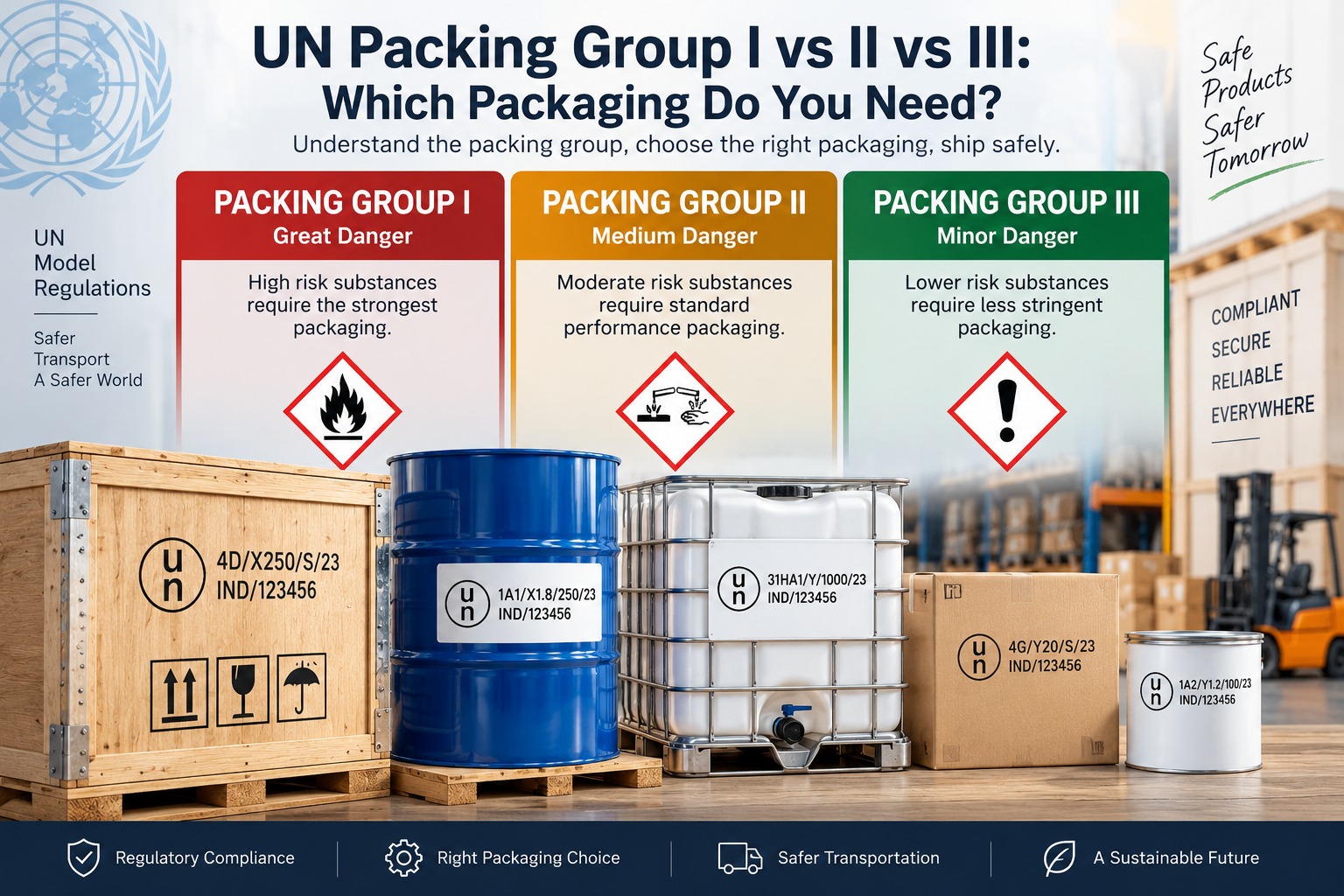
UN Packing Group I vs II vs III: Which Packaging Do You Need?
If you ship anything classified as a dangerous good, you have probably run into the term "packing group" on a safety data sheet or a shipping label. It sounds technical, but the idea behind it is simple. Not every hazardous material is equally dangerous, so the UN system sorts them into three tiers and matches each tier to a packaging strength requirement. Get the group wrong and you risk a rejected shipment, a customs hold, or worse, a package that fails in transit.
This guide breaks down UN Packing Group I vs II vs III in plain terms: what each group means, how packaging is tested and marked for it, and how to figure out which one applies to your product.
What Is a UN Packing Group?
A packing group is not a hazard class. Your hazard class (flammable liquid, corrosive, oxidizer, and so on) tells you what kind of danger a substance presents. The packing group tells you how severe that danger is within the class you have already identified.
The UN Model Regulations, along with parallel rules like 49 CFR in the US and the IMDG Code for sea transport, split hazardous materials into three packing groups:
Packing Group I – Great danger
Packing Group II – Medium danger
Packing Group III – Minor danger
The assignment depends on quantitative criteria specific to each hazard class. For flammable liquids, that means flash point and boiling point. For corrosives, it means how long the substance takes to damage skin tissue and at what concentration. You do not choose the packing group yourself. It is determined by lab testing or by referencing the substance's entry in the Dangerous Goods List.
Here is why this matters for packaging. Once you know the packing group, you know exactly how tough your container needs to be, because each group has its own performance testing standard. For certain applications, LLP Approved wooden boxes may also be considered when selecting suitable packaging, provided the packaging meets the applicable dangerous-goods requirements and performance standards for the specific substance and transport mode.
Packing Group I: Great Danger
Packing Group I covers substances that pose the highest risk during transport. Think of concentrated acids, certain organic peroxides, and highly flammable liquids with very low flash points.
Packaging rated for Packing Group I has to pass the most demanding version of every UN performance test: drop testing from a greater height, higher hydrostatic pressure resistance, and stacking tests under heavier loads. On the package marking, this shows up as an "X" in the packing group code, for example "1A1/X1.4/150."
An X-rated package is the most versatile in one sense. Since it has passed the toughest tests, it can also legally carry Packing Group II and III materials (within certain weight and specific gravity limits). But you cannot go the other way. A package rated only for Group II or III can never be used for Group I goods, even if it looks similar or comes from the same product line.
Packing Group II: Medium Danger
Packing Group II is where most commercial and industrial chemicals fall. This includes many paints, solvents, pesticides, and moderately corrosive cleaning agents.
Packaging tested for Group II carries a "Y" mark. It has passed a meaningful but less severe version of the drop and stack tests compared to Group I. A Y-rated package can be used for Group II or Group III materials, but never for Group I.
Because Group II covers such a wide range of everyday industrial shipments, this is usually the packaging category exporters and manufacturers need the most. UN-approved drums, fiberboard boxes, and jerry cans are frequently tested and certified to this level since it balances safety with practical cost.
Packing Group III: Minor Danger
Packing Group III is the lowest tier. These are still regulated dangerous goods, but the risk they present is comparatively minor. Common examples include some flammable liquids with higher flash points and mildly irritating substances.
Packaging for Group III carries a "Z" mark and only needs to pass the lightest version of the performance tests. A Z-rated package can only be used for Group III goods. It cannot be substituted for Group I or II shipments under any circumstance.
Quick Comparison: PG I vs PG II vs PG III
| Factor | Packing Group I | Packing Group II | Packing Group III |
|---|---|---|---|
| Danger level | Great | Medium | Minor |
| Package mark | X | Y | Z |
| Can also hold | I, II, III | II, III | III only |
| Testing rigor | Highest | Moderate | Lowest |
| Typical examples | Concentrated acids, certain peroxides | Solvents, paints, pesticides | Mildly irritating liquids, some flammables |
How to Read a UN Package Marking
Once you understand the packing group, the rest of the marking on a drum or box starts to make sense. A typical code looks like this: UN 1A1/Y1.4/150/26/IND/M1234.
UN confirms it follows the United Nations standard.
1A1 identifies the packaging type, in this case a closed-head steel drum.
Y1.4 shows the packing group rating (Y for Group II/III) and the specific gravity it was tested to.
150 is the hydrostatic test pressure in kilopascals.
26 is the year of manufacture.
IND is the country of approval.
M1234 is the manufacturer's code.
If any of these numbers do not match your shipment's requirements, the packaging is not compliant, no matter how sturdy it looks.
Why Getting the Packing Group Right Actually Matters
Choosing packaging below the required group is one of the easiest violations for a customs or transport inspector to catch, since it is stamped right on the container. Beyond the compliance risk, there is a real safety angle. Packaging tested to a lower standard than your material's actual hazard level is more likely to leak, crack, or fail under the exact conditions it is meant to withstand, like a drop during loading or pressure changes in an aircraft hold.
On the flip side, over-specifying is not usually a violation, but it does add unnecessary cost. A Group I rated drum for a Group III liquid works, but you are paying for testing and material strength you do not need.
Where India-Specific Certification Comes In
If you are shipping dangerous goods out of India by air or sea, your UN-rated packaging also needs an IIP certificate. The Indian Institute of Packaging (IIP), set up under the Ministry of Commerce, is the only body in India authorized by the Directorate General of Shipping and the Directorate General of Civil Aviation to test and certify this packaging. Without a valid IIP UN Mark, carriers and freight forwarders will not load the cargo, regardless of how the packaging is built.
This is where working with a specialized supplier saves time. Needhi DG Packaging is a Mumbai-based manufacturer that produces UN-approved and IIP-certified packaging matched to specific packing groups, including UN/IIP approved wooden boxes, IIP certified fiberboard boxes, IIP approved packages, IIP certified FIBC jumbo bags, and IIP certified IBC tanks. You can also review the company's IIP certification information before finalizing your export packaging. Each product line is built and tested against the group rating the material actually requires, rather than a generic "one size fits all" spec.
Choosing the Right Packaging for Your Shipment
Here is a simple way to approach it:
Confirm your material's UN number and packing group from your SDS or the Dangerous Goods List. Do not guess based on how the product "feels" in terms of risk.
Match the group to the package mark. Group I needs X-rated packaging. Group II needs Y or X. Group III needs Z, Y, or X.
Check the specific gravity limit on the packaging mark against your actual product's density, especially for liquids.
Verify the IIP certificate is current if you are shipping from India. Certificates lapse after 9 or 18 months depending on whether the manufacturer is ISO certified.
Keep documentation on hand. Carriers and customs officials may ask for the test certificate behind the marking, not just the marking itself.
Final Thoughts
The difference between UN Packing Group I, II, and III comes down to how much danger a substance poses and how rigorously its packaging has been tested to contain that danger. Group I demands the strongest packaging and the strictest testing. Group II sits in the middle and covers the largest share of commercial shipments. Group III requires the least, but it is still regulated and still needs proper certification.
Getting this right protects your shipment, your workers, and your compliance record. If you are unsure which group applies to your product or which packaging fits, checking with a certified manufacturer like Needhi DG Packaging before you finalize your shipment is a straightforward way to avoid costly mistakes later.
Frequently Asked Questions
- 1. Can I use Packing Group I packaging for a Group III product?
- 2. How do I find out which packing group my product falls under?
- 3. Is IIP certification the same as UN approval?
- 4. What happens if I ship with the wrong packing group packaging?
- 5. Do all hazardous materials get assigned a packing group?