
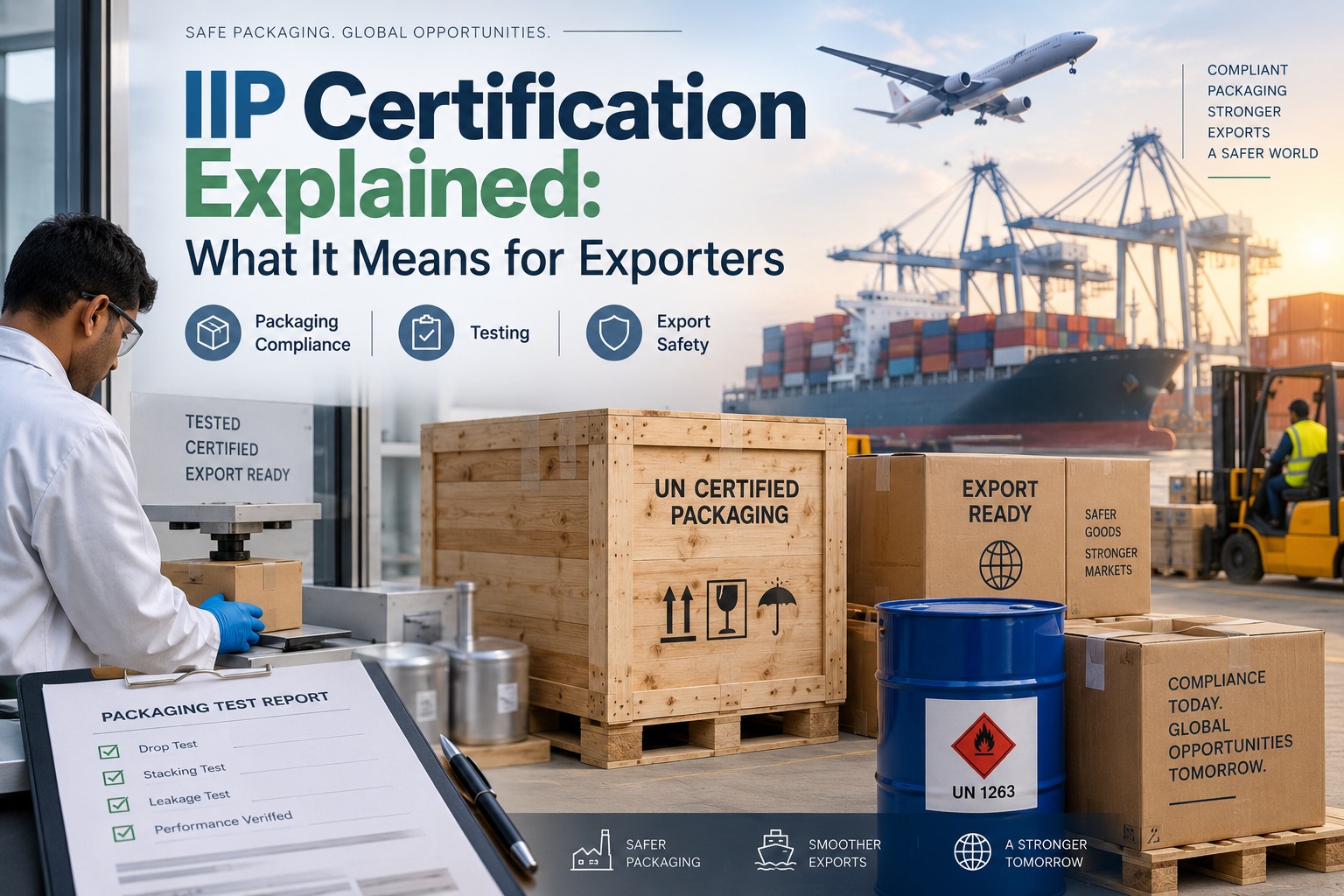
IIP Certification Explained: What It Means for Exporters
If your business ships anything classified as a dangerous good out of India, by air or by sea, you have probably come across the term IIP certification. Maybe a freight forwarder mentioned it, or a shipment got held up because of it. Either way, it is not optional paperwork. It is a legal requirement, and without it, your cargo simply will not fly or sail.
This guide breaks down IIP certification explained in plain terms: what it is, who issues it, how the process actually works, and what exporters need to keep in mind so shipments do not get delayed at the last minute.
What Is IIP Certification?
IIP certification, often called the UN Mark Certificate or UN Certificates Services, is a document issued by the Indian Institute of Packaging that confirms your packaging has passed the required performance tests for transporting hazardous or dangerous goods. It applies to packaging like drums, jerry cans, fiberboard boxes, wooden boxes, FIBC bags, and IBC tanks used to carry chemicals, flammable liquids, corrosives, and other regulated materials.
The certificate proves that your packaging can survive the drops, stacking pressure, vibration, and pressure changes it is likely to encounter during transport, without leaking or failing. Once your packaging passes testing, it gets a UN Mark, and that mark, backed by the certificate, is what airlines, shipping lines, and customs officials look for before they accept dangerous cargo.
Who Is the Indian Institute of Packaging?
The Indian Institute of Packaging (IIP) is an autonomous body set up in 1966 under the administrative control of India's Ministry of Commerce. Its broader mission is improving packaging standards across the country, but for exporters of hazardous goods, its most important role is being the only body in India authorized to test and certify UN packaging.
The IIP holds this authority from two government agencies:
Directorate General of Shipping (DG Shipping) – for hazardous cargo moving by sea
Directorate General of Civil Aviation (DGCA) – for hazardous cargo moving by air
Because these are the same authorities that regulate how dangerous goods move through Indian ports and airports, a certificate from any other lab or agency will not be accepted as a substitute. If your packaging does not carry a genuine IIP certificate, carriers are within their rights to refuse the shipment outright.
Why IIP Certification Matters for Exporters
Here is why this matters beyond just ticking a compliance box. Dangerous goods that leak, rupture, or shift during transport put handlers, aircraft, ships, and other cargo at real risk. The whole point of UN-style testing is to catch weak packaging before it ever reaches a loading dock.
For exporters specifically, IIP certification affects four things directly:
Whether your cargo is accepted at all. Airlines and shipping lines check for the UN Mark before loading. No mark, no shipment.
Customs clearance speed. Missing or expired certification is a common reason shipments get held up at the port or airport.
Legal liability. If uncertified packaging fails in transit and causes damage or injury, the exporter carries the responsibility, not just the packaging manufacturer.
International acceptance. IIP certification aligns with IMDG (sea) and IATA/ICAO (air) regulations, so certified packaging is recognized well beyond Indian borders.
The IIP Certification Process, Step by Step
The process is fairly standardized regardless of the packaging type. Here is how it generally works:
Identify the packaging and hazard class. Before applying, confirm the UN number, hazard class, and packing group of the material you plan to ship. This determines which tests your packaging needs to pass.
Submit an application on the IIP portal. Applications are filed online with the manufacturer's login credentials, along with technical details of the packaging design.
Pay the required fees. Fee structures vary by mode. Normal processing is the standard route, while a Tatkal (expedited) option is available at a higher cost for exporters who need faster turnaround.
Send packaging samples for testing. Samples are sent to the IIP laboratory in Mumbai or Chennai by courier or transport. Samples are typically retained for around 30 days after testing.
Laboratory testing. The IIP conducts the relevant performance tests, drop test, stacking test, vibration test, hydraulic pressure test, and Cobb test for water resistance, depending on the packaging type and material.
Certificate and UN Mark issuance. Once the packaging passes, the IIP issues the test report and the UN/IIP certificate, along with a UN Mark number specific to that packaging design.
Documents Typically Required
While exact requirements can vary slightly by hazard class, exporters generally need to have the following ready before applying:
Company registration and business details
Material Safety Data Sheet (MSDS) for the product being shipped
Technical specifications of the packaging (material, dimensions, construction)
Packaging design drawings or samples
Details of the hazard class and UN number
Getting these documents organized upfront is one of the easiest ways to avoid back-and-forth delays with the IIP.
How Long Is an IIP Certificate Valid?
Certificate validity depends on whether your manufacturing facility holds ISO certification:
18 months for manufacturers with ISO certification
9 months for manufacturers without ISO certification
This means certification is not a one-time task. Exporters need to track expiry dates and renew before the certificate lapses, since an expired certificate makes otherwise compliant packaging unusable for new shipments.
Common Mistakes Exporters Make With IIP Certification
Waiting until the shipment date to apply. Testing and certificate issuance take time, and rushing through Tatkal processing every time adds unnecessary cost.
Assuming a UN Mark from another country covers Indian export requirements. It does not. Packaging manufactured or shipped from India needs IIP certification specifically.
Letting certificates expire mid-contract. A long-term supply agreement can easily outlast a 9-month certificate if nobody is tracking the renewal date.
Changing packaging specs without retesting. Any change to the packaging design, thickness, closure, or inner packaging can invalidate the original certificate.
Where a Certified Supplier Makes the Process Easier
One practical way exporters simplify this is by sourcing packaging directly from a manufacturer that already holds current IIP certification across its product range, rather than certifying custom packaging from scratch for every shipment.
Needhi DG Packaging, based in Mumbai, supplies UN-approved and IIP-certified packaging built for exactly this purpose. Their range includes UN/IIP approved wooden boxes, IIP certified fiberboard boxes, IIP approved packages, IIP certified FIBC bags and jumbo bags, and IIP certified IBC tanks, all tested and certified to match specific packing groups and hazard classes. Working with a supplier that already carries valid certification on its standard product lines can shorten the time between order and shipment considerably, compared to certifying a new packaging design from zero.
What Happens if You Skip IIP Certification?
Skipping this step is not a minor risk. Without a valid IIP certificate:
Airlines and shipping lines can legally refuse to load your cargo
Customs authorities can hold or reject the shipment at the port
You lose the international recognition that comes from IMDG and IATA/ICAO alignment
You carry direct liability if the packaging fails during transit
None of these outcomes are worth the shortcut, especially since the certification process itself is well-documented and predictable once you know the steps.
Final Thoughts
IIP certification is the document that turns UN-tested packaging into legally shippable packaging for dangerous goods leaving India. It is issued exclusively by the Indian Institute of Packaging, backed by DG Logistics and DGCA authority, and it requires periodic renewal based on your facility's ISO status. For exporters, the certificate is not paperwork for its own sake. It is what stands between your shipment moving on schedule and it sitting at a port waiting for compliance to catch up.
If you are setting up a new export line or sourcing packaging for hazardous goods, working with a supplier that already carries current IIP certification, like Needhi DG Packaging, is a straightforward way to keep your shipments compliant without managing the certification process from scratch.
Frequently Asked Questions
- 1. Is IIP certification the same as UN certification?
- 2. How long does it take to get an IIP certificate?
- 3. Can I use packaging certified in another country for exports from India?
- 4. What happens if my IIP certificate expires mid-shipment cycle?
- 5. Does every type of packaging need separate IIP certification?