
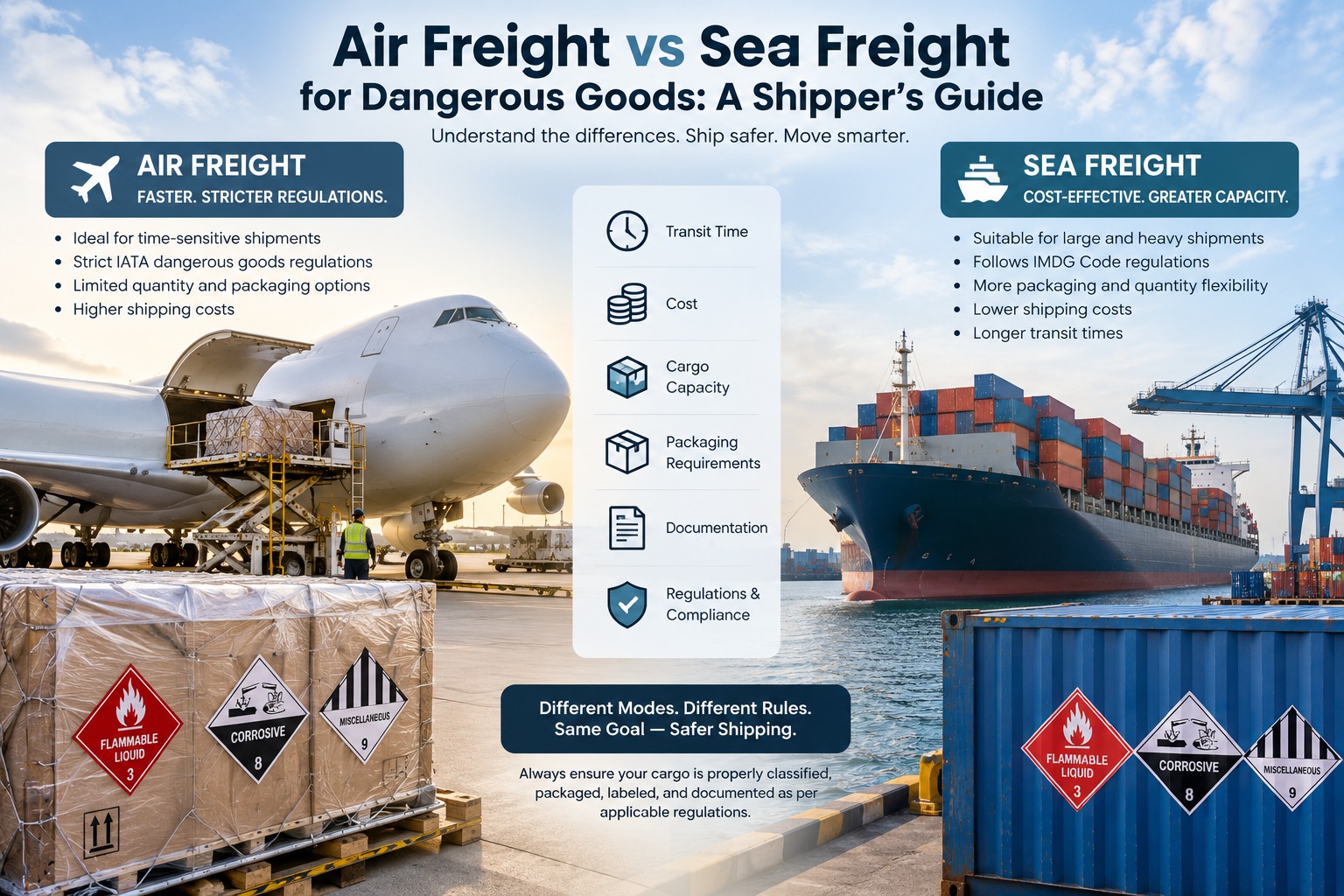
Air Freight vs Sea Freight for Dangerous Goods: A Shipper's Guide
Deciding between air and sea for a dangerous goods shipment is not just a question of speed and cost. Each mode operates under its own regulatory framework, its own packaging rules, and its own quantity limits. A packaging setup that clears customs for sea transport can be completely non-compliant for the same product moving by air.
This guide walks through air freight vs sea freight for dangerous goods so you know which regulations apply, how the requirements actually differ, and how to decide which mode fits your shipment.
The Two Rulebooks: IATA DGR and IMDG Code
Both air and sea transport of dangerous goods trace back to the same foundation, the UN Recommendations on the Transport of Dangerous Goods, commonly called the Orange Book. This is where the nine hazard classes, UN numbers, and packing groups originate. From there, each mode layers on its own mode-specific rules.
IATA DGR (Dangerous Goods Regulations) governs air transport worldwide. It is built on the ICAO Technical Instructions, reissued annually, and adds airline-specific and country-specific variations on top of the base UN rules. Because a leak or fire inside an aircraft has nowhere to vent and nowhere to be safely contained mid-flight, IATA DGR is generally the strictest of the two regimes for a given substance.
IMDG Code (International Maritime Dangerous Goods Code) governs sea transport under the SOLAS Convention, adopted by the International Maritime Organization. It updates on a two-year amendment cycle rather than annually, and it introduces maritime-specific concepts like marine pollutant classification, container packing certificates, and detailed segregation tables for how different hazard classes must be stowed relative to each other on a vessel.
Here is why this matters for shippers: the exact same UN number, the exact same chemical, can carry different quantity limits, different permitted packaging, and different documentation depending on which mode it travels by. Treating IMDG compliance as automatically sufficient for an air shipment is one of the most common and costly mistakes exporters make.
Key Differences Between Air and Sea Freight for Dangerous Goods
- 1. Quantity Limits
- 2. Packaging Requirements
- 3. Lithium Battery Rules
- 4. Documentation
- 5. Segregation and Stowage
- 6. Revision Cycle
Choosing Between Air and Sea for Your Shipment
Beyond the regulatory differences, a few practical factors typically drive the mode decision:
Speed versus cost. Air freight Services moves faster but generally costs significantly more per kilogram than sea freight, especially for bulk hazardous shipments.
Volume and weight. Sea freight handles large volumes and heavy shipments, like full drum pallets or IBC tanks, far more economically than air.
Shelf life and urgency. Time-sensitive hazardous materials with short shelf lives, or urgent replacement parts and chemicals, often justify the added cost of air transport.
Hazard class restrictions. Some dangerous goods, particularly certain Class 1 explosives and specific lithium battery configurations, face outright restrictions or extremely limited quantities for air transport, making sea the only practical option regardless of urgency.
Port and airport congestion. Dangerous goods often face limited storage capacity at ports and cargo terminals. Extended holds due to documentation issues can trigger demurrage or storage charges, so getting the paperwork and packaging right the first time matters for both modes.
Where Packaging Choice Fits Into the Decision
Regardless of which mode you choose, your packaging needs to be tested and certified to match that specific mode's requirements, not just the general UN standard. This is especially relevant for shippers moving the same product by both air and sea at different times, since packaging validated for one mode may need re-verification for the other.
For exporters shipping out of India, packaging also needs a valid IIP certificate from the Indian Institute of Packaging on top of its UN mark, regardless of whether the cargo is going by air or by sea. Needhi DG Packaging, based in Mumbai, supplies UN-approved and IIP-certified packaging built for both air and sea dangerous goods shipments, including dangerous goods packaging services, including UN/IIP approved wooden boxes, IIP certified fiberboard boxes, IIP approved packages, IIP certified FIBC bags and jumbo bags, and IIP certified IBC tanks. Having packaging already certified against both regulatory frameworks removes one variable from a decision that already has enough moving parts.
Common Mistakes When Switching Between Modes
Assuming IMDG-compliant packaging works for air. Packing instructions and quantity limits are not identical between the two codes, even for the same UN number.
Reusing a sea freight Shipper's Declaration for an air shipment. The documentation format and required fields differ enough that this usually gets flagged.
Overlooking lithium battery restrictions when switching from sea to air. A battery shipment that moved fine by sea may be restricted or require different state-of-charge documentation for air.
Not rechecking segregation requirements. A container packing plan built for maritime segregation rules will not automatically satisfy air cargo compatibility requirements.
A Quick Decision Checklist
Identify the UN number, hazard class, and packing group of your material.
Check both IATA DGR and IMDG for quantity limits and packing instructions specific to that UN number.
Confirm your packaging is UN-certified and IIP-certified for the mode you are shipping by.
Prepare the correct Shipper's Declaration format for your chosen mode.
Factor in cost, urgency, and volume to settle on air, sea, or a combination for different legs of the journey.
Final Thoughts
Air freight and sea freight for dangerous goods are not two versions of the same process. They run on separate regulatory codes, with different quantity limits, packing instructions, documentation formats, and segregation rules, even when the underlying UN classification of the material is identical. Choosing the right mode means weighing cost and urgency against these compliance differences, not just picking whichever option is cheaper or faster on paper.
If you are unsure whether your current packaging holds up under both IATA DGR and IMDG requirements, working with a certified supplier like Needhi DG Packaging can help confirm your packaging is genuinely ready for the mode you plan to ship by.
Frequently Asked Questions
- 1. Is air freight always stricter than sea freight for dangerous goods?
- 2. Can I use the same UN-certified drum for both air and sea shipments?
- 3. Why are lithium battery rules different for air versus sea?
- 4. Do I need separate documentation for air and sea dangerous goods shipments?
- 5. Does IIP certification apply to both air and sea shipments from India?